
What is Dyslexia?
Dyslexia can make learning to read harder, but it doesn't have to limit a child's potential.
Dyslexia is a learning difference that primarily affects how a person learns to read and spell. Children with dyslexia find it harder to recognize words accurately and quickly, connect letters with sounds, or develop reading fluency.
Dyslexic readers tend to be right-brain dominant, which makes them creative, but they struggle with reading because they decode language using the creative right side of the brain instead of the left side.
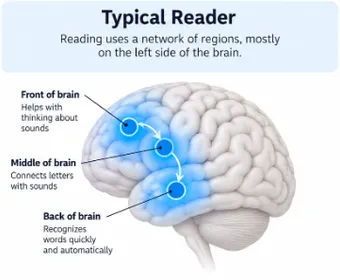
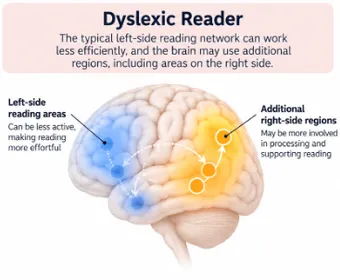
For over 15 years we have helped dyslexic learners become fluent readers. Becoming a successful reader requires hard work and consistent practice.
Children with dyslexia need Evidence Based Literacy Instruction that directly targets their unique skill gaps.
At Online Reading Tutor, using our patented reading assessment, we identify why a child is struggling and provide individualized support to help them become confident, fluent readers.
Join thousands of dyslexic students who have improved their reading comprehension using our app.
1 in 5
children show signs of dyslexia; most go undiagnosed
30-40%
of 4th graders aren't yet fluent readers (National Reading Panel)
40%
of self-made millionaires are dyslexic (source TBD)
What Makes Our Approach So Effective?
The gap
Whole-word instruction falls short
Traditional reading instruction relies on memorizing word shapes. This fails dyslexic readers, who require systematic training to break words down into phonemic units.
The method
Systematic, explicit instruction
Structured literacy directly and sequentially teaches letter-sound connections with high repetition, building automatic decoding skills.
Our approach
Built on short, intense, personalized daily practice
We combine Evidence Based Literacy Instruction (EBLI) with daily, bite-sized practice and human tutor support. Training 5 to 7 days a week achieves reading fluency much faster than long sessions 3 or 4 days a week.
Our solution
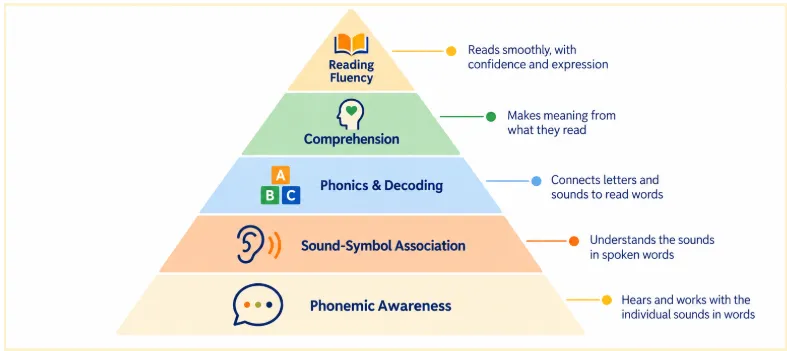
Our solution provides a personalized step-by-step approach designed to build reading fluency.
Imagine One Year From Now
Imagine your child:
- Reading independently
- Participating confidently in class
- Enjoying books instead of avoiding them
- Feeling proud of their progress
- Believing in themselves again
That's why we do this work.
Because every child deserves the opportunity to experience the joy and confidence that comes from reading.
Common myths, debunked
Myth
Dyslexia is more common in boys.
Reality
Research shows dyslexia occurs at similar rates in boys and girls. Girls are simply underdiagnosed more often, in part because they're more likely to mask reading struggles.
Myth
Dyslexic kids "see letters backwards."
Reality
Most dyslexic readers can copy text accurately. The difficulty is in naming and decoding: a child might copy the word "was" correctly but read it aloud as "saw." It's a sound-symbol issue, not a vision issue.
Myth
Clumsiness or left-handedness are signs of dyslexia.
Reality
Neither is a reliable indicator. Dyslexia is diagnosed through reading and phonological-processing assessment, not physical traits.
Brilliant minds who struggled to read
Dyslexia has never been a ceiling on what someone can achieve. It's been documented in the histories of these five, and many other people who went on to change the world in their own field.
Leonardo da Vinci
Renaissance polymath: painter, inventor, and scientist, whose notebooks are full of famously mirror-written text.
Thomas Edison
Held over 1,000 patents, including the phonograph and a practical electric light bulb.
Walt Disney
Founded Walt Disney Productions and pioneered the modern animated feature film.
Steve Jobs
Co-founded Apple and helped define personal computing, mobile devices, and modern design.
Richard Branson
Built the Virgin Group into a global brand spanning music, travel, and space exploration.
"Reading is the golden ticket that every child has the right to expect." (Dr. Julia O'Sullivan, Canadian Education Statistics Council)
How it works
Our structured path from reading assessment to fluent reading
No guesswork, no generic worksheets. Every student follows the same proven arc: assess, plan, practice, support, each calibrated to their specific skill gaps.
Take the 10-minute assessment
A short, engaging assessment (available on web, iOS, and Android) measures phonemic awareness and decoding skill against grade-level expectations, and flags exactly where the gaps are.
Get a personalized, structured-literacy-based plan
Structured literacy directly teaches the explicit connections between letters and sounds, in a defined sequence, with lots of repetition. Your child's plan delivers it through Orton-Gillingham, a multisensory method used since the 1930s and considered the gold standard for dyslexia intervention, sequenced across the five foundational skills defined by the National Reading Panel: Phonemic Awareness, Phonics, Fluency, Vocabulary, and Comprehension.
Practice daily, 25-30 minutes
Short, structured, and sequential: 5 to 6 days a week beats 1-2 hour weekly sessions for building automatic decoding. The training adapts as your child masters each skill, so practice is never too easy or too far ahead.
Stay supported by a reading tutor
A system alone isn't enough: a trained tutor reviews progress, answers questions, and keeps the plan calibrated as your child improves, so the program adjusts with them instead of running on autopilot.
Find your child's unique skill gaps
The reading assessment will indicate why your child struggles and provide a path forward.